


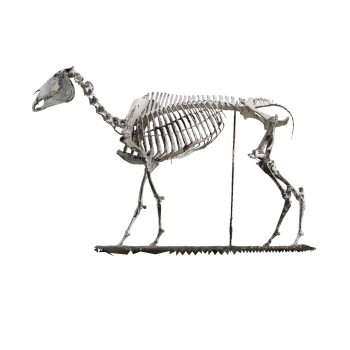
Horse skeleton
Horses are herbivorous animals belonging to the genus Malcoma in the order Quetziformes, and currently exist as two subspecies: domesticated horses and wild horses. Wild horses have upright and non drooping mane on their necks, extremely short forehead hair, long tail hair, and no distance hair on their limbs. In summer, the upper body is light brown, red brown, and reddish brown, while in winter, the back of the skin is light brown; Family horses are divided into heavy, small, and miniature horses according to their breeds; Jiama has long limbs, solid bones, well-developed tendons and ligaments, hard hooves, diverse fur colors, mostly chestnut, green, and black, well-developed sweat glands, and strong chewing power. With a developed system, it has a keen sense of hearing and smell, strong sensitivity to light, and can also see surrounding objects at night.

Rhinoceros skeleton
Rhinoceros is a large mammal in the family Rhinocerotidae of the order Rhinoceros. Fat and clumsy, with thick and rough skin arranged in folds; The fur is sparse and hard; The ears are oval in shape; Big and long head; Short and thick neck; No canine teeth; The tail is thin and short, and the body is yellow brown, brown, black or gray; Solid single or double horns on the head and nose; Both males and females have double horns, with females having longer horns than males. Rhinos are distributed in Asia, such as India in South Asia; It inhabits sparse grasslands and dense forests in tropical and subtropical regions. They often come out to forage in the early morning, evening, or night, with poor vision and sensitive sense of smell and hearing; Living alone often with little contact between individuals.

Amazon parrot skull
The Amazon parrot is a bird species of the Amazon parrot genus in the parrot family of the parrot order, also known as the orange winged Amazon parrot. The body is strong and sturdy, with a square shaped tail that is relatively short; The face is covered in hard hair; The mouth is thick and strong, with a hooked shape. Most of the feathers are green, with yellow green edges; Orange iris of the eyes; Yellow between the crown, eyes, and thighs; The main flight feathers are purple blue, and the secondary flight feathers are purple blue and distributed in the feather petals and wing tips; There is a slight red color at the turning point of the wings.. Has migratory habits. They feed on figs, nuts, flowers, seeds, and fruits, and sometimes forage in crops such as banana groves or corn fields.

Pigeon skull
Pigeons are animals of the pigeon genus in the pigeon family of the pigeon shaped order. The body length is 295-360 millimeters. The head, neck, chest, and upper back are slate gray, with metallic green and purple flashes on the upper back and front chest. The rest of the back is light gray, with a black horizontal spot on each wing. The tail feathers are slate gray, with a wide black horizontal spot at the end, similar to males and females. Widely distributed, except for Antarctica, high latitude regions in the Northern Hemisphere, and extremely arid areas in deserts. Most of them inhabit forests or forests, while some inhabit open areas or near cliffs. Active during the day and returning to their nest at night, but trained pigeons can fly at night if they do not return to their habitat before evening.

White Rhinoceros Skull
The white rhinoceros is a mammal belonging to the family Rhinocerotidae in the order Neodactyla. The body is round and robust, the skin is thick and smooth, and the surface of the body is approximately gray; The head has special features, but the incisors and canines have degenerated. The developed 7 pairs of cheek teeth have a very thick layer of limestone; There are two horns, one large and one small, one in front and one behind. The horns are not made of bone, but are derivatives of epithelial tissue, formed by the accumulation of keratin fibers. Distributed in southern and northeastern Africa, mainly active in the morning and evening, and rolling or resting in muddy water at other times; When the weather is cool, they lie under the shade of trees and take a nap, living alone or forming small groups. They are distributed in southern and northeastern Africa and feed on grass.

Otter skull
The marmot is a mammal belonging to the family Muridae in the order Rodentia of the class Mammalia; Also known as groundhog. The largest terrestrial and burrowing herbivorous and hibernating wild animal in the squirrel family. There are 14 subspecies worldwide, with 4 species in China. Distributed in Siberia and Mongolia of Russia, and also in Inner Mongolia of China. Resting in plateaus, meadows, foothills, and other areas, the lower edge of sunny slopes in plains and mountains is its high-density aggregation zone. Active during the day, with a large appetite, gnawing on a large amount of grass every day, enduring hunger and satiety, and preferring juicy feed with high water content, post rain grass, and dew grass. Likes to live in groups, easy to drive, does not harm people, is not heat-resistant, afraid of direct sunlight, and has strong disease resistance.

South American Half Skull Fossil
Hippidion, also known as South American horse, is a member of the horse family in the order of odd hooves. In the mid-19th century, some horse fossils were discovered on the grasslands of South America and handed over to British paleontologist Richard Owen. After restoration, Owen found that they were similar to modern horses, but smaller in size and were ponies, commonly translated as South American horses in China. The body size is not as big as a donkey, with a shoulder height of less than 1.4 meters and a weight of over 200 kilograms. The body shape of a South American horse is similar to that of a pony, with a short and sturdy body, short limbs, and a large head, making it look uncoordinated. Like modern horses, it is suitable for gnawing on hard grass rich in silicon.

Fossil skull of giant ape
The giant ape is an extinct genus of ape that lived in China, India, and Vietnam about 1 to 3 million years ago, and shares the same time frame and geographical location as several hominids. It is a type of ape that lives on the ground, similar to chimpanzees. It is likely the largest ape in the world, standing up to 3 meters tall and weighing 500 kilograms. The morphological characteristics of giant apes are between those of apes and humans. Giant apes have strong canine teeth and huge molars, with teeth about five times larger than modern human teeth. It is as easy as breaking a toothpick to bite through bamboo that is as thick as a bowl mouth. My favorite food is bamboo, and occasionally I also eat leaves and fruits.

Elephant skeleton
Elephantidae is a mammal belonging to the family Elephantidae in the order Longnose, consisting of two genera, and is the largest terrestrial animal in the world. Its pillar like limbs and wide feet can stably support its massive body. A huge head with fan-shaped large ears and a long and elastic nose. Elephant ears have abundant blood vessels that can effectively dissipate heat. The elephant trunk, which combines the nose and upper lip, is coordinated by over 15000 muscles. Distributed in sub Saharan Africa and southeastern Asia, it inhabits various living environments, especially forests, grasslands, and river valleys. Living in groups, male beasts occasionally live alone. Eating plants, with a large appetite.
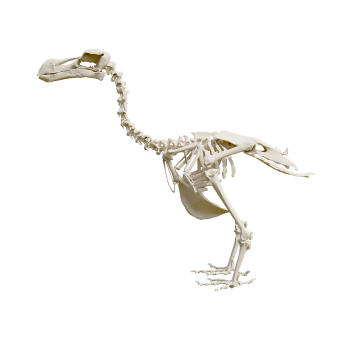
Fossil skeleton of Dodo bird
Raphuscucullatus: an extinct bird species in the pigeon family of the pigeon shaped order. The body shape is comparable to that of a swan, and there are also obvious sexual dimorphism. It is a large bird with a body length of 70-90 centimeters and a weight of 17-28 kilograms. There is a white feather on the tail. Their wings are too small to lift the Dodo off the ground. Eating fruits and seeds. This species is a non flying bird found only on the island of Mauritius in the Indian Ocean. Within just 200 years of its discovery by humans, this bird was completely extinct due to hunting and human activities.
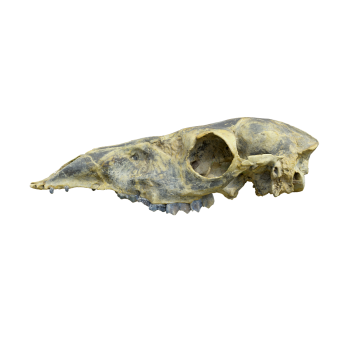
Upper skull of camel
Camel genus, belonging to the family Camelidae in the order Artiodactyla, is divided into two types based on morphology: Bactrian camels and Bactrian camels. Also known as "Tuotuo". Its head is small, the neck is thick and long, curved like a goose's neck, with double eyelids and thick long eyelashes, and the nose can be freely closed. It can reproduce and thrive on barren desert grasslands, and can still work without drinking water or eating forage for 5-7 days. Camels enjoy eating hard branches, tall shrubs, foul smelling grasses, and thorny plants. Has high economic value. Camel milk can be processed into dairy products such as yogurt, butter, white oil, cheese, dairy beverages, etc; Camel manure is one of the fuels used by herdsmen for heating. It is known as the 'ship of the desert'.

Camel skull
Camel deer is a mammal of the camel genus in the family Camelidae of the order Artiodactyla. Camel deer have a larger body size, generally ranging from 2-2.6 meters in length. The body resembles a camel, with four long legs similar to a camel. The shoulders are high, the head is large, the eyes are small, the face is long, the neck is short, the nose is enlarged and slightly drooping, and the upper lip is 5-6 centimeters longer than the lower lip. The hair color of the whole body is brown, the nose is thickened, and there is a chin pouch under the throat. Named after the hump shaped back hump and the horn shaped lower jaw. Typical subarctic coniferous forest animals, wandering in groups in the forest clearing, like to eat tender branches of plants, move quickly and agilely, and can run quickly. Long legs, able to walk freely even in thick snow

Fossil skull of woolly rhinoceros
The woolly rhinoceros is a mammal belonging to the family Rhinocerotidae in the order Neodactyla. The woolly rhinoceros is an extinct species of rhinoceros, named after its thick and dense fur covering its entire body. The woolly rhinoceros has strong bones, a long and large skull, and a head and neck that droops downwards; There is a rhinoceros horn on both the forehead and nose bones. The woolly rhinoceros has a body length of about 4 meters and a shoulder height of about 2 meters. It is covered with warm long hair and thick fur, and has a thick layer of fat under its skin. Like mammoths, they are all ice age animals that adapted to the cold climate and have traveled throughout the northern part of the Eurasian continent. They mainly inhabit the Eurasian grasslands and feed on shrubs and grasses grown in cold climates.

Beaver skull
The beaver (scientific name: Castorfiber) is an animal of the beaver family and genus. The body of a beaver is enlarged, with no significant difference between males and females. The head is short and dull, the eyes are small, the neck is short, the limbs are short and wide, the forelimbs are short, the feet are small and have strong claws, the hind limbs are thick and strong, and the tail is large and flat. Nighttime activity, rarely going out of caves during the day, good at swimming and diving, not hibernating, weak self-defense ability, timid, fond of eating tender branches, bark, and roots of various plants. The skull is related to biting trees, exceptionally solid, with well-developed bone ridges and prominent sagittal and herringbone ridges. The nasal bone is wide in front and narrow in the back. The cheekbones are particularly thick. The incisors are chiseled in shape and suitable for biting through branches and trunks.
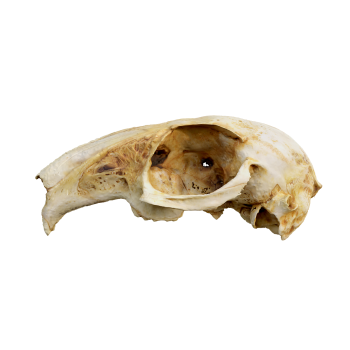
Upper skull of desert cotton tailed rabbit
Sylvilagusauduboni: a mammal belonging to the genus Sylvilagusauduboni in the family Actinidae. Body length 30-38 centimeters, ear length 7 centimeters, weight 0.85-1 kilograms. Females are slightly larger than males. The fur is generally light brown, brown or gray; The lower abdomen of the body turns white; The throat often has an orange brown stripe; The tail wraps around and looks like a cotton ball. The habitat is dry grasslands, shrubs, coastal areas, and juniper forests. Usually inactive at noon, foraging in the early morning and evening. It is a herbivore that feeds on various plants, including grass, shrubs, leaves, and cacti.

Dolphin skull
The finless porpoise is a mammal of the order Rodentia and family Hylidae. Large body size. Wide head, short and round ears, small eyes; The kiss is thick and short, with a truncated front end and a large upper lip; The limbs are short and thick, with four toes on the forefoot and three toes on the hind foot, with slight webbed spaces between the toes; The body hair is thick and sparse, with a dark grayish yellow color. Distributed in South America, living in the Amazon River basin. They inhabit riverbanks or swampy areas, often in family clusters. Gentle in personality, quiet in nature, slow in movement, able to quickly jump into the water and escape when faced with danger. Proficient in swimming and diving, able to swim long distances underwater or hide in aquatic plants for extended periods of time without moving. Feed on reeds and other plants in the river.

Deer skull
The elk (scientific name: Elaphurus davidianus) is the only deer species in the family Deer and genus Deer. Because its head and face are long and narrow like a horse, its horns are slightly different from other deer, its hooves are wide like cows, and its tail is slender like a donkey, it is also known as the Four Elephant. Its horn shape is unique, opposite to the horns of other deer. The front branch splits into smaller branches, while the back branch hardly splits. The limbs are sturdy, the main hooves are broad and fleshy, with well-developed hanging hooves, and there is a loud knocking sound when walking. I prefer swamp and wetland habitats and feed on green grass and aquatic plants. Good at socializing, good at swimming, and enjoys eating tender grass and aquatic plants.

Fossil skull of Egyptian heavy footed beast
The scientific name of the Egyptian heavy footed beast was taken in honor of the queen of Ptolemy II, Arsinoe II, as the initial fossils were found near the ruins of her palace. The bones found here are the only complete, and the most famous species is the Qi's heavy footed beast. It is about 4.5 meters long, 2.5 meters high, and weighs about 4 tons. The most prominent feature of the Egyptian heavy footed beast is a pair of giant horns protruding from its nose. It has 44 strong teeth in its mouth, which can easily chew rough and hard plants. The Egyptian heavy footed beast evades the hunting of most predatory animals with its massive body. The era of life was approximately 37 to 23 million years ago.

Rabbit skull
Rabbits are herbivorous vertebrates belonging to the Rabbit family of the Rabbit order. The rabbit head is small, slightly longer, the mouth is shorter, the upper lip has a longitudinal cleft, the eyeball is larger, and the eye color varies with the breed; Large ears, upright or drooping, thin skin, underdeveloped sweat glands, only a few sweat glands near the lips, and respiratory function of the skin. Commonly found in deserts, grasslands, dry grasslands, forests, or forests. Has nocturnal and drowsy characteristics, is very active at night, and appears quiet during the day, timid and easily startled, with a gentle temperament but poor social behavior. Herbivorous animals feed on the roots, stems, leaves, and seeds of plants, and only eat their favorite foods.
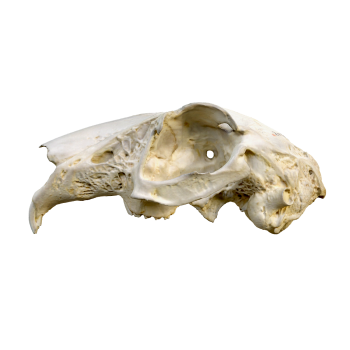
Rabbit upper skull
Rabbits are herbivorous vertebrates belonging to the Rabbit family of the Rabbit order. The rabbit head is small, slightly longer, the mouth is shorter, the upper lip has a longitudinal cleft, the eyeball is larger, and the eye color varies with the breed; Large ears, upright or drooping, thin skin, underdeveloped sweat glands, only a few sweat glands near the lips, and respiratory function of the skin. Commonly found in deserts, grasslands, dry grasslands, forests, or forests. Has nocturnal and drowsy characteristics, is very active at night, and appears quiet during the day, timid and easily startled, with a gentle temperament but poor social behavior. Herbivorous animals feed on the roots, stems, leaves, and seeds of plants, and only eat their favorite foods.

Male roe deer upper skull
The roe deer (scientific name: Capreolus pygargus) is a species of deer in the family Deer and genus Deer. The body length is about 1.2 meters, the weight is about 30 kilograms, and it has a slender neck and large eyes and ears. No fangs, hind limbs slightly longer than forelimbs, short tail, male roe deer with horns, female without horns, male long horns only divided into three forks. They inhabit different types of deciduous forests, mixed forests, and forest grasslands, and are active in sparse forest belts, river valleys, and gentle slopes. The family group consists of female roe deer and their offspring, usually 3-5 individuals, and male roe deer only join the group in midsummer. Morning and evening activities, most active at night, herbivorous animals. Usually twins.

Two toed sloth skull
The two toed sloth is a mammal of the genus Two toed sloth in the family Malodontidae, also known as the sloth. Body length is about 70 centimeters, tail degeneration, weight is about 9 kilograms; There are two claws on the forelimbs and three claws on the hind limbs, with well-developed claws; The body hair is long and thick, green due to the growth of lichens and algae, the skull is short and tall, the nose and snout are relatively short, and it has a zygomatic arch. Distributed in South and Central America. Residing in damp forests. Lost the ability to move on the ground, hung upside down on a tree with four limbs, moved slowly, slept upside down after eating, and could even sleep in this position for a long time, swimming. Highly sensitive to low temperatures, feeding on leaves, tender shoots, and fruits.
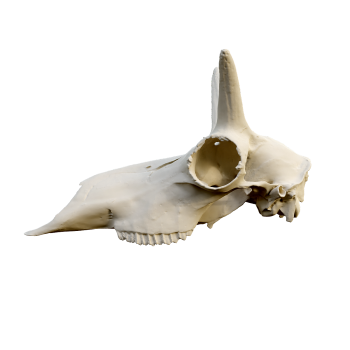
Upper skull of pronghorn
The pronghorn is a mammal belonging to the pronghorn family and the pronghorn genus. The body length is about 1.5 meters and the shoulder height is about 1 meter. Males weigh around 50 kilograms, while females weigh around 40 kilograms. Medium in size, well proportioned and agile. It inhabits semi-arid open grasslands at elevations of 900-1800 meters from northern Mexico to southern Canada. Mixed male and female clusters in winter, grouping in early spring, with young males and females separated, and adult males moving alone. The food consists of various grasses and shrubs, and even rough or poisonous plants that livestock do not eat. Vigilant personality, sharp vision, good at running, with a maximum speed of nearly 100 kilometers per hour.

Male antelope skull
Inu antelope is a small antelope that mainly lives in the shrublands of South Africa and East Africa. The shoulder height of the Inu genus is about 30-40 centimeters and its weight is 3-5 kilograms. They have a long nose and a layer of soft fur. The hair on the forehead is erect, while the male's forehead hair sometimes partially covers the short and circular horns. The antelope genus is generally a semi nocturnal animal that mainly feeds before dawn and after dusk. It will be hunted by giant lizards, eagles, pythons, wildcats, lions, cheetahs, stray dogs, jackals, and humans. Herbivorous, mainly fed on leaves, stems, fruits, and berries. They only consume the water in their bodies as water compounds to reduce the frequency of drinking water.

Popular Models
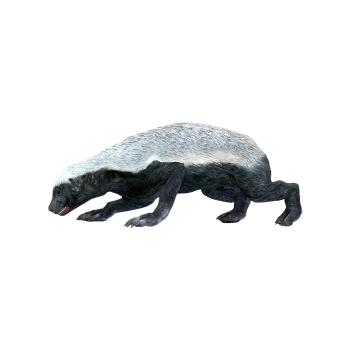
Honey Badger (3D animated model)
192 View
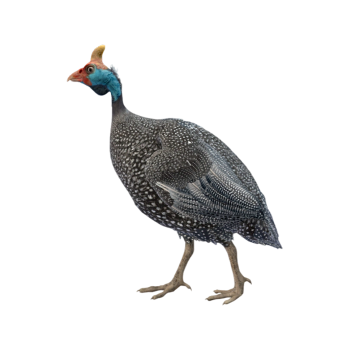
Guinea fowl (3D animated model)
163 View
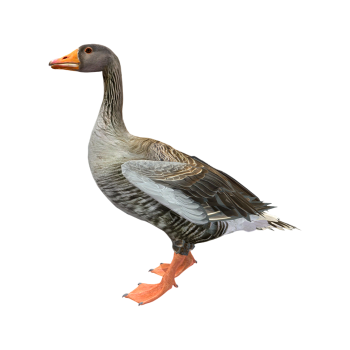
Wild Goose (3D animated model)
185 View
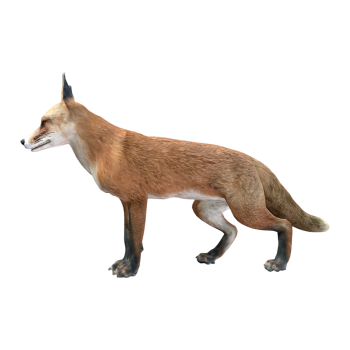
Red Fox (3D animated model)
153 View
Random Model

Select chair
540 View

Parry Albert's bust sculpture
492 View

Caracalla Red Meat Navel Orange
878 View

Coca-Cola in glass bottles
978 View


Nefertari Temple Statue Ramses II
532 View
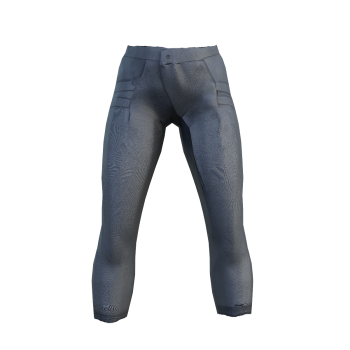
Black Fit Jeans
798 View


Nymphs 3D model animation
770 View